Multi-Tenant Guardrails for Agentic AI: Rate Limiting and Cost Attribution as One Layer
Why multi-tenant agent platforms should use one trusted identity for real-time rate limiting and cost attribution.
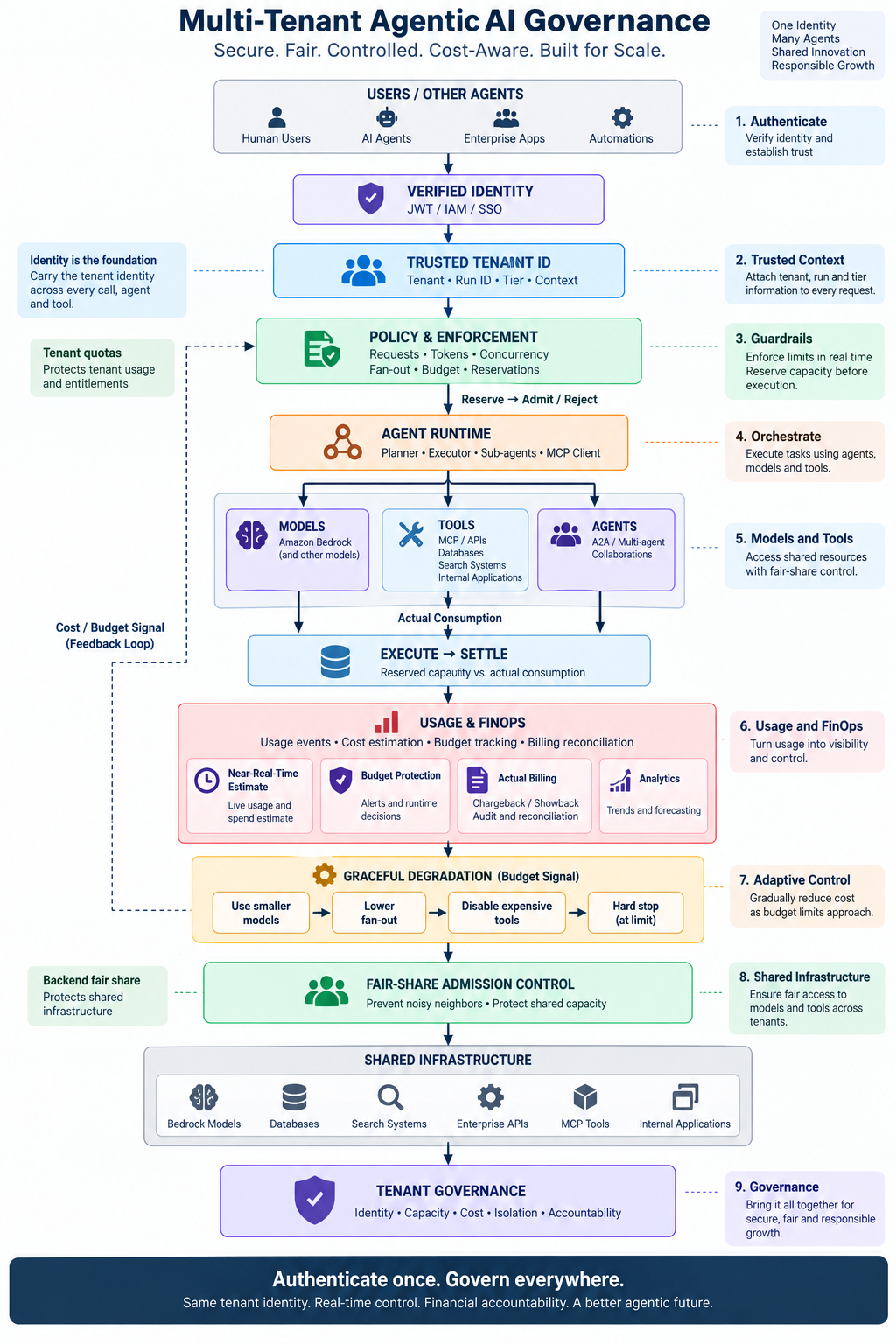
AI agents behave differently from traditional APIs.
A normal API request may result in one backend operation. An agent request can trigger planning, multiple model calls, tools, other agents, retries, and parallel execution.
So one user request can easily become 10, 20, or 30 downstream operations.
For a shared multi-tenant platform, this creates two questions:
How do I stop one tenant from consuming too much capacity?
How do I know how much each tenant is costing me?
These are different problems, but they should share the same foundation.
The Problem: One Request Doesn’t Mean One Unit of Cost
Consider two tenants.
Tenant A asks:
“Summarize this document.”
The workflow creates four downstream operations.
Tenant B asks:
“Analyze these documents, search our systems, validate the findings, and create a recommendation.”
That workflow might create 30 operations.
From the gateway perspective, both started as one request.
From an infrastructure and cost perspective, they are completely different.
This is why simple requests-per-second limits are not enough for agentic systems.
There Are Really Two Problems
1. Traffic Control
Traffic controls protect the platform while the workflow is running.
They can limit:
- Requests
- Tokens
- Concurrent operations
- Agent fan-out
- Budget consumption
These decisions often need to happen within milliseconds.
2. Cost Attribution
Cost attribution answers a different question:
“How much did this tenant actually consume?”
It supports chargeback, showback, FinOps, budgeting, billing, and audit.
But billing data is retrospective. It tells you what already happened; it cannot stop an expensive workflow while it is running.
Think of It as One Problem Running on Two Clocks
Fast clock — milliseconds
Used for runtime controls such as rate limits, token limits, concurrency, fan-out, and budget protection.
Slow clock — minutes or hours
Used for actual billing, reconciliation, chargeback, FinOps, and audit.
Both need the same foundation:
the same trusted tenant identity.
The Key Architecture Principle
Do not identify the tenant one way for rate limiting and another way for FinOps.
Instead, establish the tenant identity once and reuse it throughout the workflow.
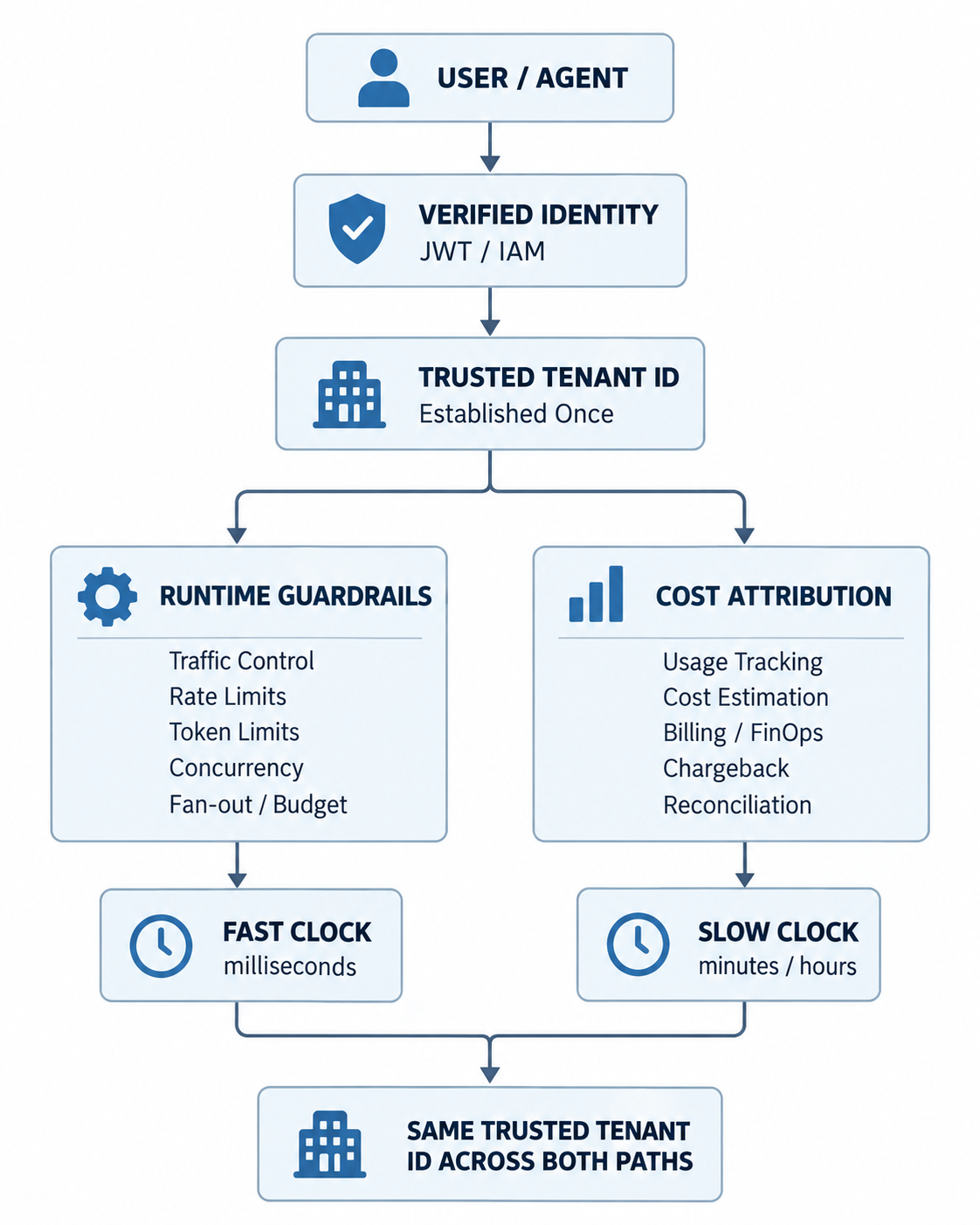
Tenant identity should come from trusted authentication such as a verified JWT claim or authenticated IAM identity.
It should not come directly from a user-controlled value such as:
X-Tenant-ID: customer-aOtherwise, a client could potentially impersonate another tenant.
Multi-Tenant Agentic AI Governance Architecture
The architecture can be viewed as six logical zones.
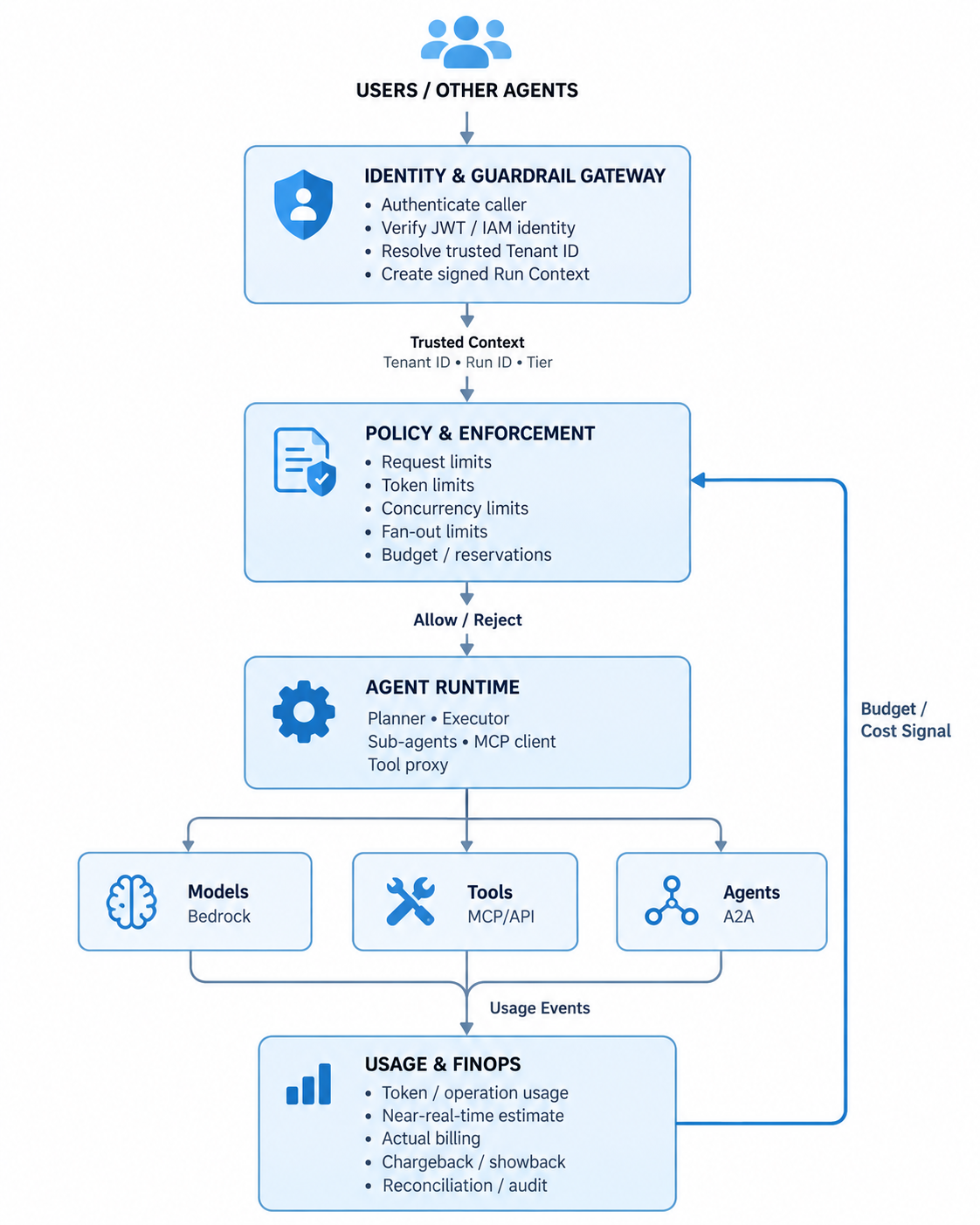
1. Users and Other Agents
Requests may originate from users, applications, services, or other agents.
An important rule is:
Another agent should not automatically be trusted just because it is inside your environment.
Tenant identity must continue across every agent and tool call.
User
 ↓
Agent A
 ↓
Agent B
 ↓
MCP Tool
 ↓
Model
If identity disappears halfway through the chain, downstream activity may look like it came from one shared service account.
You lose both quota enforcement and cost attribution.
2. Identity and Guardrail Gateway
The gateway establishes the trusted tenant context.
JWT / IAM
    ↓
Verify identity
    ↓
Resolve tenant
    ↓
Resolve policy
    ↓
Create trusted run context
That context might include:
tenant_id
run_id
tier
project
remaining_fanout
reservation_id
The platform creates this context — the user does not.
It should be short-lived and validated again when crossing important A2A or MCP boundaries.
3. Policy & Enforcement
Different tenants may have different limits.
The policy layer can independently control:
Requests — how much work can the tenant start?
Tokens — how much model capacity can it consume?
Concurrency — how many operations can run at once?
These limits should remain separate because a tenant can have a normal request rate while consuming a very large number of tokens.
Why Token Reservation Is Important
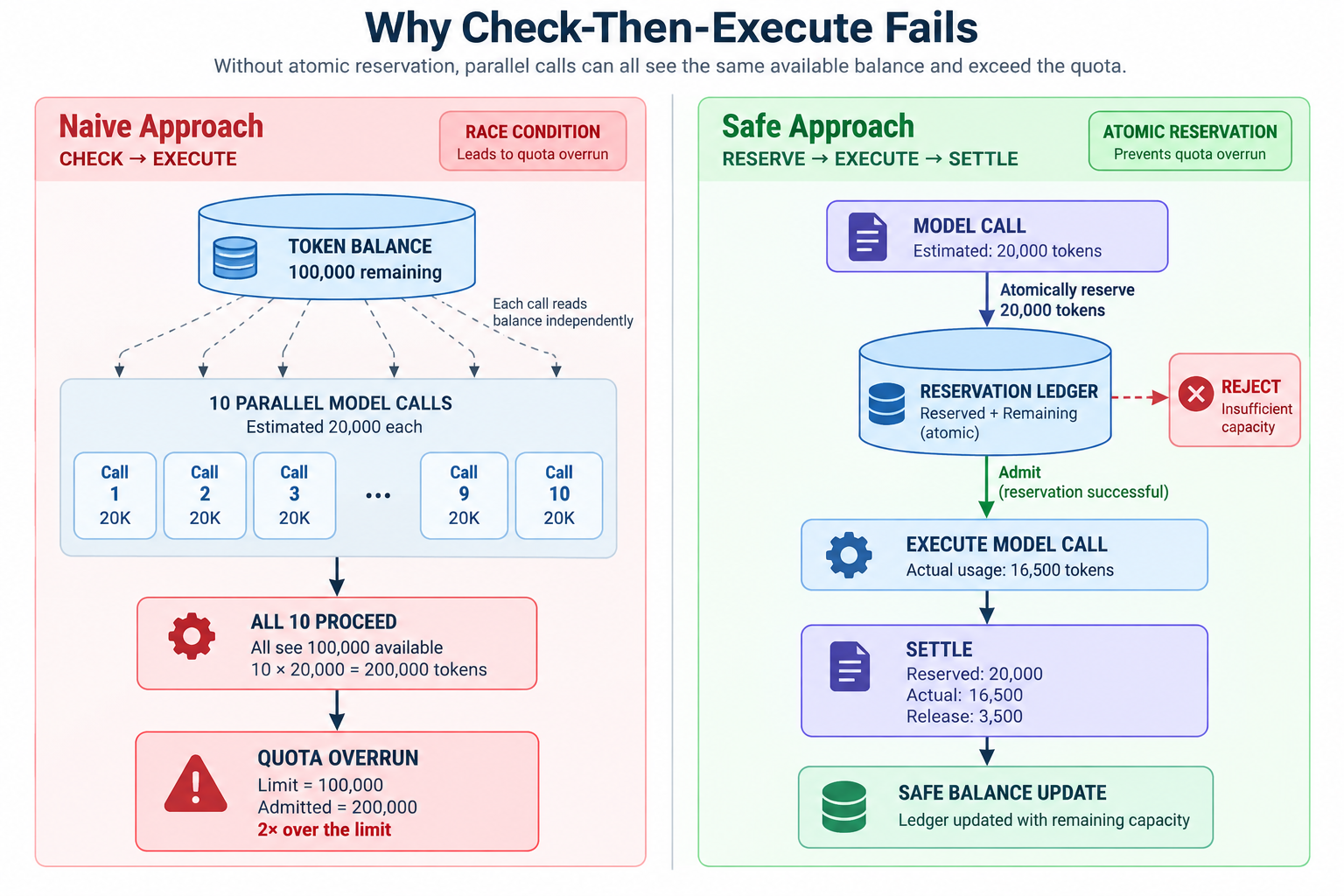
Multiple model calls can run in parallel. If every call checks the same available balance independently, they may all proceed and exceed the tenant’s quota.
Instead, reserve the estimated tokens atomically before execution. When the call completes, settle the reservation using the actual usage and release unused capacity.
Reserve → Execute → Settle prevents parallel agents from spending the same quota twice.
4. Agent Runtime
The runtime may contain planners, executors, sub-agents, MCP clients, and tool proxies.
Every downstream call should preserve the trusted run context.
Tenant A
   ↓
Planner
   ↓
Research Agent
   ↓
MCP Tool
   ↓
Bedrock
All of these operations should still be attributable to the same tenant and run.
The runtime should carry identity — not create or widen it.
5. Models and Enterprise Tools
The runtime eventually calls shared resources such as Bedrock models, APIs, databases, search systems, MCP tools, and internal applications.
Tenant quotas protect against a tenant exceeding its assigned entitlement.
But a tenant can still remain within its quota while consuming most of the available shared backend capacity.
That creates the noisy-neighbor problem.
Tenant Quota
     ↓
Is the tenant within its limits?
     ↓
Fair-Share Admission
     ↓
Is shared capacity available fairly?
     ↓
Models / Tools / APIs
Tenant quotas protect tenant-level usage.
Fair-share admission protects shared infrastructure.
6. Usage and FinOps
Every model, tool, or agent call should emit a usage event tied to its tenant and run.
Tenant
   ↓
Model / Tool / Agent
   ↓
Usage Event
   ↓
Estimated Cost
These events provide a near-real-time estimate of spend.
As a tenant approaches its budget, the platform can progressively reduce expensive activity.
$7,000  → Normal operation
$9,000  → Smaller models
$9,500  → Reduce fan-out
$9,800  → Disable expensive tools
$10,000 → Hard stop
This gives us two views:
Runtime usage protects the budget now.
Actual billing later provides FinOps, chargeback, and reconciliation.
When This Architecture Makes Sense
This approach becomes valuable when one platform serves many tenants, shares model or MCP capacity, supports multi-agent workflows, requires chargeback/showback, or has meaningful financial risk from runaway execution.
In simple terms:
If one deployment serves many consumers, tenant-level governance becomes increasingly important.
When You Probably Don’t Need It
The full architecture may be unnecessary if you have only one tenant, every tenant already has isolated infrastructure, or you are still running a small prototype.
Start simpler:
Per-tenant rate limit
        +
Token limit
        +
Cloud billing review
Add stronger governance as usage and complexity grow.
The Main Takeaway
Agentic AI changes the economics of a request.
One request can expand into:
Model calls
+
Agent calls
+
Tool calls
+
Retries
+
Tokens
That creates two risks:
Operational risk — a tenant consumes too much shared capacity.
Financial risk — an agent workflow generates more cost than expected.
The answer is not just another rate limiter or another FinOps dashboard.
The foundation is a trusted tenant identity carried across the entire workflow.
Authenticate once. Govern everywhere.
Carry the same trusted tenant identity across every agent, model, and tool call — and use it to connect runtime protection, shared-capacity fairness, cost control, and financial accountability.
References
- 01Configure rate limits for AI traffic on AgentCore gatewayvendor-engineering
- 02Part 2: Amazon Bedrock cost attribution with Amazon Athena and CUDOSvendor-engineering